Christmas & New Year with Dogs: The Do’s, Don’ts & Doggy Disasters to Avoid
From chocolate Santas and disappearing baubles to New Year’s Eve fireworks, here’s how to keep the festive season merry, bright and safe for your four-legged family members.
Christmas. The season of goodwill, overindulgence, beautifully decorated trees and dogs who suddenly discover an extraordinary number of things they’re not supposed to eat.
For us, it’s a wonderful time of year. For our dogs, it’s an absolute wonderland of interesting smells, exciting visitors, mysterious parcels and tempting food.
Unfortunately, some of those festive delights can turn Christmas into an unexpected trip to the vet.
So, before the celebrations begin, here are a few things worth remembering.

DON’T: Share Your Chocolate
We know. Those big, pleading eyes.
Surely one little chocolate won’t hurt?
Unfortunately, chocolate is genuinely dangerous for dogs. It contains theobromine and caffeine, substances dogs cannot process as efficiently as humans.
Dark chocolate, cooking chocolate and cocoa powder are particularly dangerous, although milk chocolate can also cause poisoning. The risk depends on the amount eaten, the type of chocolate and the size of your dog.
And remember those chocolate decorations hanging on the Christmas tree? Your dog may have spotted them long before you did.
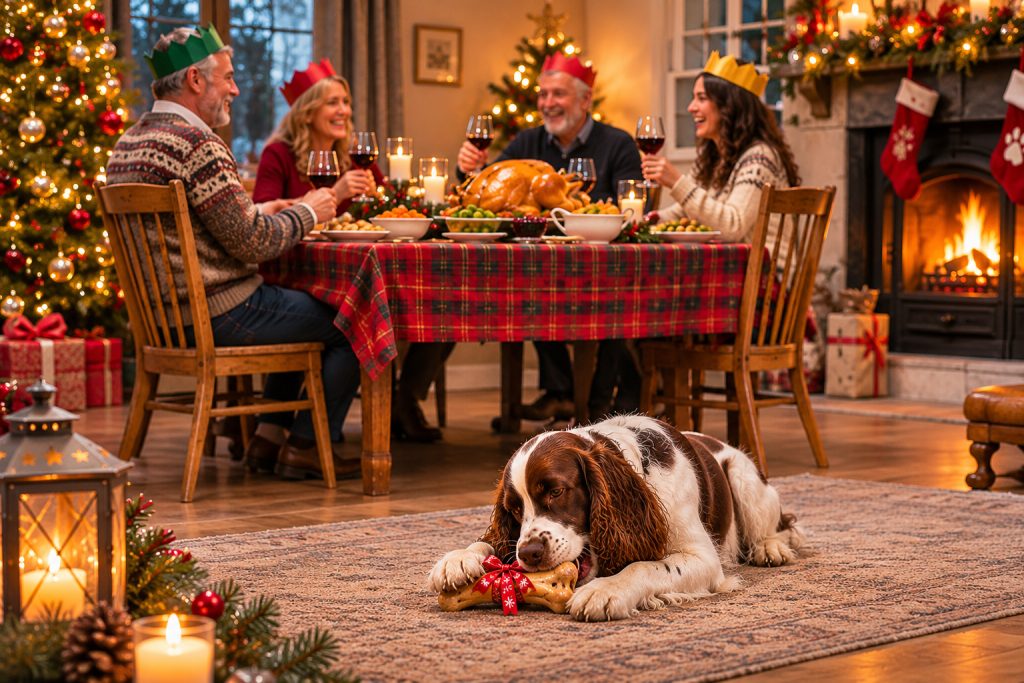
DON’T: Let Your Dog Help Themselves to Christmas Dinner
Christmas dinner smells wonderful. Unfortunately, not everything on our plates belongs in a dog’s bowl.
Some particular things to watch out for:
Grapes, raisins, sultanas and currants: These can cause serious kidney damage. That means Christmas pudding, mince pies and Christmas cake are firmly off the doggy menu.
Onions, garlic, leeks and chives: Whether raw, cooked or hidden in stuffing and gravy, these can damage a dog’s red blood cells.
Cooked bones: Turkey and chicken bones can splinter, causing choking or serious internal injuries.
Rich, fatty foods: Turkey skin, fatty leftovers and rich gravy can cause digestive problems and sometimes pancreatitis.
Alcohol: Keep drinks, alcohol-soaked puddings and unattended glasses out of reach.
Xylitol (also called birch sugar): This sweetener, found in some sugar-free products, is extremely dangerous to dogs.
Macadamia nuts: These can cause weakness, vomiting, tremors and other symptoms.
Mouldy leftovers: Definitely not something to let the dog investigate.
DO: Give Them Their Own Christmas Treat
Nobody wants to be the Christmas Grinch.
A little plain, cooked, boneless turkey is generally fine for most healthy dogs, provided there’s no seasoning, onion, garlic, skin or gravy.
A few suitable vegetables, such as plain carrots or green beans, can make a lovely festive addition too.
Or better still, give your dog a treat or toy that’s actually intended for dogs.
They’ll be delighted. And you’ll have one less thing to worry about.

DON’T: Underestimate the Christmas Tree
Ah, the Christmas tree.
A beautiful centrepiece for the festive season.
Or, as some dogs see it, an enormous indoor stick covered in toys.
Baubles: Glass decorations can shatter, causing cuts to paws and mouths. Plastic decorations can also be dangerous if chewed or swallowed.
Tinsel and ribbons: These are particularly tempting to playful dogs, but swallowing them can cause dangerous intestinal blockages.
Tree lights: Chewing electrical cables can cause burns or electric shock. Keep cables secured and out of reach.
Real Christmas trees: Fallen needles can irritate mouths and stomachs, while drinking water from the tree stand may be harmful, particularly if additives have been used.
Salt-dough decorations: These homemade ornaments can contain dangerously high amounts of salt if eaten.
The tree itself: An enthusiastic tail, an inquisitive nose or a determined puppy can bring the entire thing crashing down.
Secure the tree properly, keep fragile decorations higher up and consider leaving the lower branches undecorated.
If you have a particularly determined Christmas-tree enthusiast, a barrier around the tree might be the best decoration you buy this year.
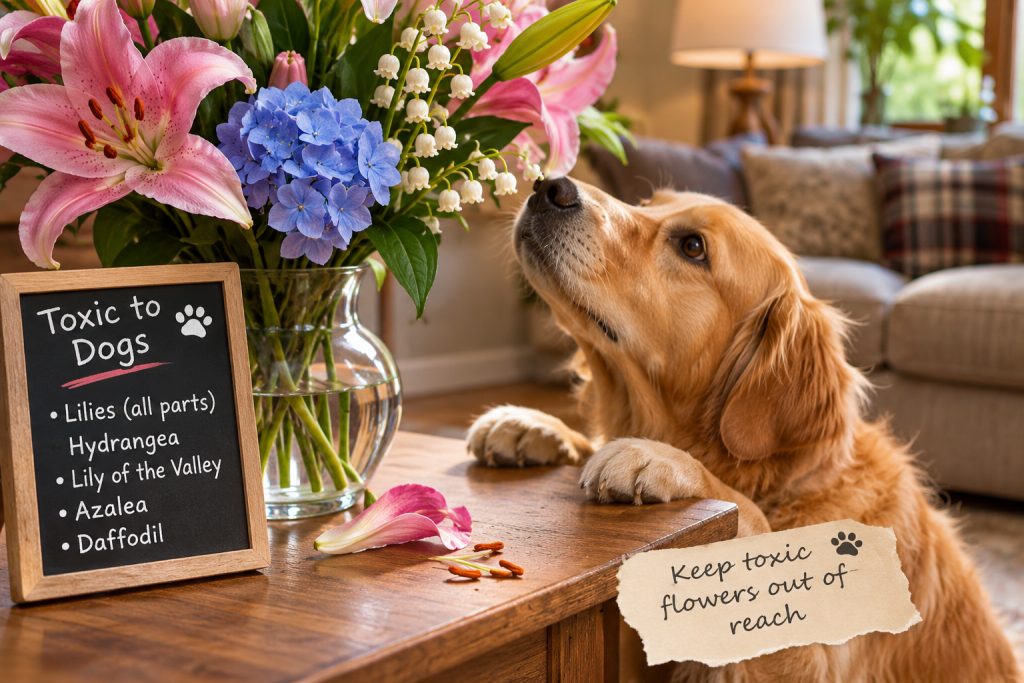
DON’T: Forget About Christmas Plants
Those beautiful seasonal plants deserve a little thought too.
Poinsettias: These can irritate a dog’s mouth and stomach, although they are generally less poisonous than their reputation suggests.
Holly: The berries and leaves can cause vomiting and diarrhoea if eaten.
Mistletoe: This can be harmful, with some varieties posing greater risks than others.
Lilies: Many varieties are toxic to pets, but they’re particularly dangerous to cats. True lilies and daylilies can cause fatal kidney failure in cats, even from tiny exposures to pollen or vase water. If you have cats, it’s safest not to bring these lilies into the house at all.
The simplest solution? Keep festive plants somewhere curious noses cannot reach.

DO: Remember That Christmas Can Be Overwhelming
Not every dog enjoys a house full of visitors, excited children, unfamiliar noises and a complete change of routine.
Some absolutely love it.
Others would much rather be left in peace.
Make sure your dog has somewhere quiet and comfortable to retreat to, with their own bed and water.
Let them choose whether to join the festivities, and make sure visitors, especially children, understand when the dog needs a break.
And try to keep walks, mealtimes and bedtime routines reasonably familiar.
A little normality goes a long way.
DON’T: Leave Presents and Packaging Within Reach
Wrapped presents are fascinating.
There’s paper to tear, ribbons to pull, boxes to investigate and mysterious smells coming from underneath the tree.
Unfortunately, presents can contain chocolates, sweets, cosmetics, batteries, medicines or small objects that are dangerous if swallowed.
Keep potentially hazardous gifts somewhere secure, particularly before Christmas morning.
And once the unwrapping begins, clear away ribbons, string, plastic packaging and small toy parts.
Your dog doesn’t need to participate in every aspect of Christmas morning.
Although they may disagree.
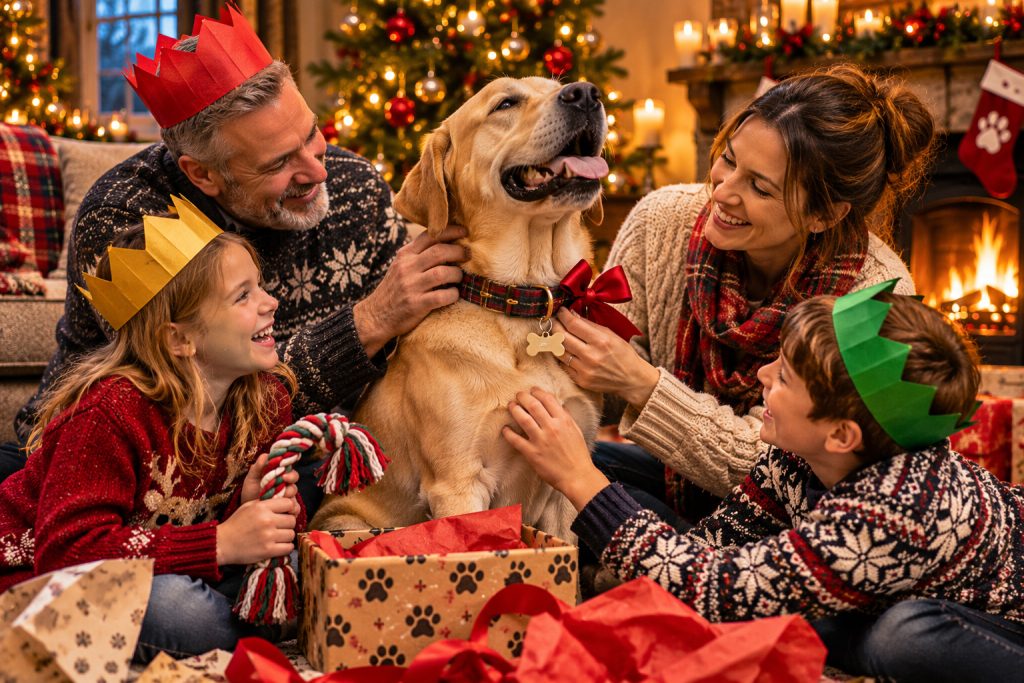
Christmas Through Your Dog’s Eyes
Christmas must be a rather baffling time for dogs.
Having spent the entire year being told that sticks, branches and assorted bits of tree are absolutely not allowed in the house, December arrives and the family drags an entire tree into the living room. Not only is this apparently acceptable, everyone is delighted!
Then they cover it in shiny things, put parcels underneath it and spend the next few weeks telling the dog to leave everything alone.
The kitchen smells extraordinary, visitors appear bearing gifts, and people who haven’t been seen for months suddenly turn up wearing paper hats and behaving rather strangely.
Then comes Christmas morning.
Everyone’s sitting on the floor, wrapping paper is flying everywhere, and suddenly the dog is being encouraged to tear something open!
There’s a new toy, perhaps a smart new collar, something delicious to eat and an enormous amount of fuss.
Naturally, some dogs take their Christmas responsibilities very seriously. Every parcel must be inspected, every visitor greeted and every dropped crumb accounted for.
Others prefer a more supervisory role, keeping one eye on the proceedings and the other firmly on the kitchen.
And somewhere, there’s a dog who has spent the entire morning happily playing with the cardboard box that the expensive new toy came in.

DON’T: Forget About New Year’s Eve!
Just when the Christmas chaos is winding down, along comes New Year’s Eve.
Champagne corks popping, parties in full swing and, of course, fireworks.
While some dogs couldn’t care less about fireworks, others find the sudden bangs and flashes absolutely terrifying.
If your dog isn’t a fan of fireworks, a little preparation can make the evening much easier.
Walk them earlier in the day, well before the fireworks are likely to start.
Close curtains and windows to help reduce the noise and flashes.
Put the television or radio on to provide some familiar background noise.
Give them somewhere comfortable to settle, whether that’s their favourite bed, a cosy corner or right beside you on the sofa.
Let them choose what they need. Some dogs want cuddles and reassurance; others prefer to hide away somewhere quiet.
Keep doors and gates secure. Even normally confident dogs can panic and bolt when startled by a loud bang.
And remember, fireworks don’t always wait until midnight. Some enthusiastic neighbours seem determined to start celebrating before you’ve even finished your dinner.
For dogs who find fireworks particularly distressing, it’s worth speaking to your vet well before New Year’s Eve about ways to help them cope.

When to Call the Vet Immediately
Some Christmas mishaps are more serious than others. If your dog eats or swallows any of the following, contact your vet straight away, even if they seem perfectly fine:
Chocolate or cocoa products
Grapes, raisins, sultanas or currants
Anything containing xylitol (birch sugar)
Alcohol
Onions, garlic, leeks or chives
Macadamia nuts
Salt-dough decorations
Medicines or batteries
Tinsel, ribbons, sharp decorations or other objects that could cause an obstruction or injury
For cats: Contact your vet immediately if your cat has chewed or licked a true lily or daylily, brushed against its pollen or drunk water from a vase containing these flowers.
Other warning signs requiring urgent veterinary attention include repeated vomiting, collapse, seizures, breathing difficulties, severe abdominal pain or unusual weakness.
Don’t try to make your dog vomit or give home remedies unless your vet specifically instructs you to.
Keep your vet’s out-of-hours telephone number handy over Christmas. Hopefully, you’ll never need it.
DO: Make Christmas Special for Your Dog
Christmas isn’t just about avoiding hazards.
It’s also about including our dogs in the celebrations in ways they’ll enjoy.
A lovely winter walk, a pile of new Christmas toys, a comfortable place to snooze or a little extra time together can make their Christmas just as special as ours.
Have Yourself a Very Merry Christmas!
With a little planning and a watchful eye, there’s no reason our dogs can’t enjoy the festive season just as much as we do.
Whether they’re helping unwrap presents, supervising the Christmas dinner preparations or snoring contentedly through the King’s Speech, they’re part of the family.
And that’s what Christmas is really about.
From all of us at Dogs & Co, we wish you and your four-legged family a very Merry Christmas and a Happy New Year! 🎄🐾